CONCORDIA NEWS
We will protect your pet with 100% care and professionalism!
 Concordia Pet Care
 2026-08-06


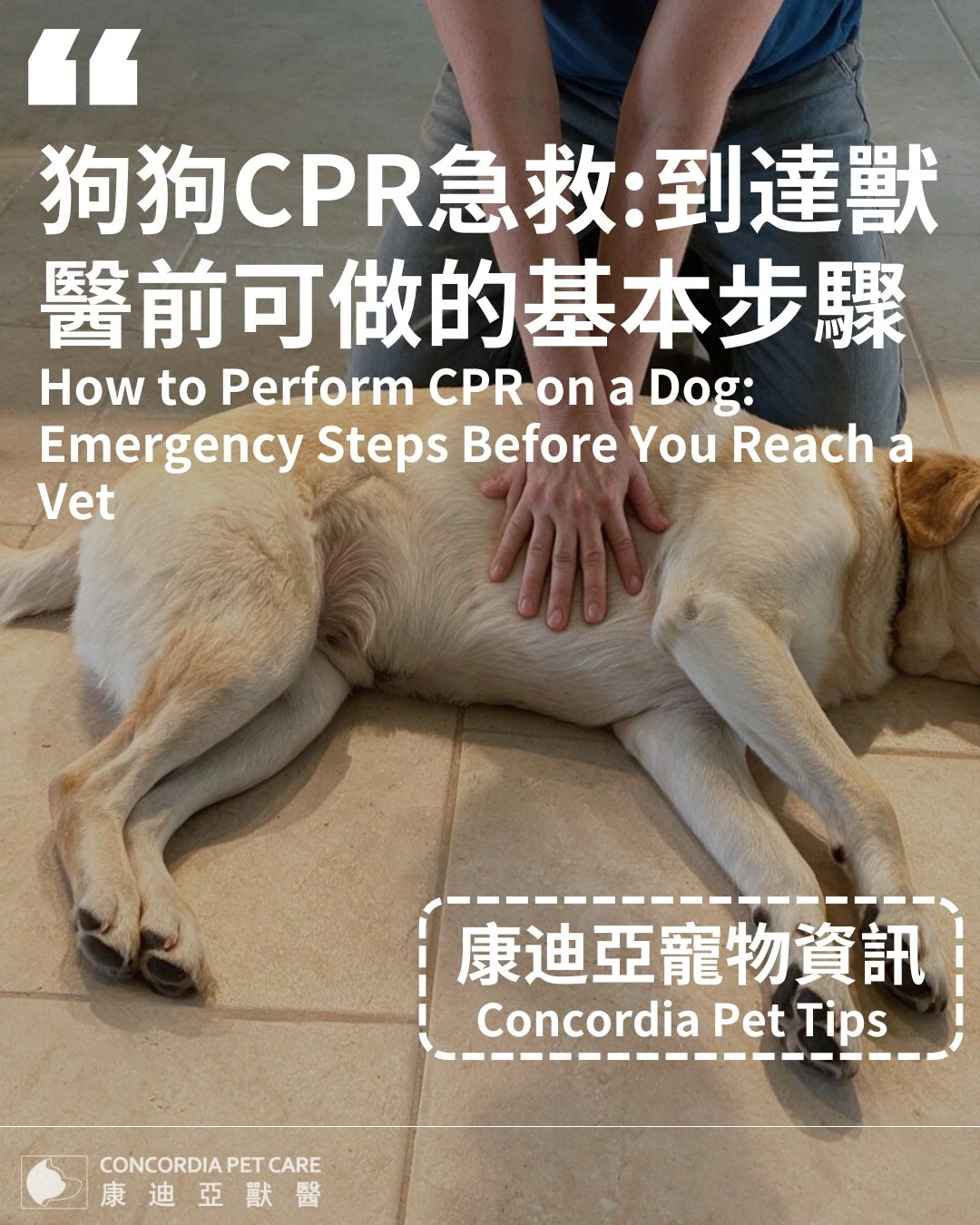
Dog CPR (cardiopulmonary resuscitation) is an emergency first-aid measure for a dog that is unresponsive and not breathing normally, or has no detectable heartbeat. CPR is not a replacement for veterinary care. Its purpose is to temporarily support circulation and oxygen delivery while you contact an emergency veterinary hospital and arrange immediate transport.
Since cardiac arrest is a stressful crisis, owners need clear steps and realistic expectations. Any dog that requires CPR needs immediate 24-hour emergency veterinary evaluation, even if they appear to recover or resume breathing on their own.
Before initiating chest compressions, quickly assess your dog's responsiveness and breathing in 10 seconds or less:
l Check Responsiveness: Call your dog’s name loudly and firmly tap their shoulder.
l Check for a Heartbeat: Place your palm directly over the left side of the chest (just behind the elbow) to feel for a heartbeat. Alternatively, you can feel for a pulse at the femoral artery on the upper inner thigh. (Note: Finding a weak pulse or faint heartbeat in a collapsed dog can be very difficult for untrained owners—if the dog is completely limp and not breathing, do not waste precious time searching for a pulse; start CPR immediately.)
l Inspect the Airway Safely: Look inside the mouth only if it is safe to do so. Do not put your hand deep inside the dog’s mouth unless an obstructing object is clearly visible and easy to remove; otherwise, you risk being bitten or pushing the foreign object deeper into the throat.
l Check Breathing & Gum Color: Look for normal chest movement. Gasping or agonal breaths are not normal breathing. Healthy gums are usually pink; pale, blue, grey, or white gums may indicate severe oxygen or circulation problems.
Crucial Rule: If your dog is conscious or breathing normally, do not start chest compressions. Keep the airway open, maintain a safe body temperature, and seek immediate veterinary attention. Do not warm a dog if heatstroke is suspected. If your dog is unresponsive and not breathing normally, have someone call the 24-hour emergency clinic immediately while you start CPR.
A dog may experience sudden collapse or cardiac arrest due to:
l Choking or airway obstruction
l Drowning or electrocution
l Severe physical trauma or road traffic accidents
l Heatstroke or severe poisoning
l Severe anaphylaxis (allergic shock)
l Pre-existing heart disease or cardiac arrhythmias
l Complications following severe or prolonged seizures
Why cause matters: CPR alone cannot correct internal bleeding, toxic exposure, severe lung damage, or underlying heart rhythm abnormalities. Emergency veterinary treatment remains essential even if your dog starts breathing again. The veterinary team will assess oxygen levels, blood pressure, blood glucose, electrolytes, and the underlying cause of the collapse.
Position your dog on their side on a firm, flat surface such as the floor. Hand placement and compression technique should be adapted to both body size and chest shape:
Toy & Small Breeds / Puppies: With the dog lying on their side, place one hand around the chest at heart level and compress between the flat part of the thumb and fingers. Depending on the dog's size and your training, a circumferential two-thumb technique or a one-handed palm technique over the heart may also be used.
Medium to Large Round-Chested Dogs: Overlap both hands, lock your elbows, and place your hands over the widest part of the chest.
Deep- or Keel-Chested Dogs (e.g., Greyhounds, Dobermans): Place your overlapped hands directly over the heart, just behind the point of the elbow.
Wide- or Barrel-Chested Dogs (e.g., English Bulldogs): If the dog can be positioned stably on their back without delaying CPR, apply compressions over the sternum. Otherwise, begin in a stable side-lying position and follow any technique learned in formal training.
l For a dog lying on their side, compress the chest by about 1/3 to 1/2 of its width. For a wide-chested dog lying on their back, the recommended depth is about 1/4 of the chest depth.
l Allow the chest to fully recoil (expand back up) between compressions.
l Aim for a rate of 100 to 120 compressions per minute (roughly to the beat of the song "Stayin' Alive").
l After about 2 minutes, pause for less than 10 seconds to check for normal breathing and a heartbeat or pulse. If another rescuer is present, switch roles promptly to reduce fatigue and resume compressions without delay if there are still no signs of circulation.
l Close your dog's mouth tightly with your hands, keeping their jaw shut.
l Gently extend their head and neck aligned with the spine to open the airway.
l Cover your dog's nostrils completely with your mouth and blow gently until you see their chest rise.
l Give 2 rescue breaths for every 30 compressions. Avoid blowing with excessive force, especially in small dogs or puppies.
Note on Compressions-Only CPR: CPR with 30 compressions and 2 breaths is preferred for a non-intubated dog. If mouth-to-nose breathing is unsafe or you are unable to provide it, continue chest compressions at 100–120 per minute while arranging immediate veterinary help rather than stopping CPR altogether.
Continue CPR while transport is being arranged. During transport, CPR should only be attempted by a second person when it can be done without compromising vehicle safety; the driver must never attempt CPR. If your dog resumes normal breathing, stop compressions, keep the airway open, monitor closely, and proceed directly to the emergency clinic.
Warning: Dogs that regain consciousness or breathing after collapse remain in a highly unstable state and can deteriorate rapidly without advanced veterinary life support.
Upon arrival, the emergency veterinary team will assess the dog and may continue or adjust resuscitation measures, including:
l Providing oxygen support and establishing intravenous access when indicated
l Using emergency resuscitation medication when clinically indicated
l Monitoring heart rhythm and assessing circulation using appropriate equipment
l Performing emergency blood tests, fluid therapy, and stabilisation when appropriate
Preparing for Rapid Decision-Making: In a critical emergency, the veterinary team may ask for consent to begin stabilisation before every diagnostic answer is known. Supporting oxygen delivery and circulation usually takes priority over completing a full diagnostic work-up.
The best time to learn pet CPR is long before a crisis occurs. Here are practical steps every owner can take today:
l Save Emergency Contact Numbers: Store your primary clinic and the nearest 24-hour emergency hospital phone numbers in your phone favorites.
l Know the Route: Map out the fastest driving route to the nearest 24-hour veterinary facility.
l Take a Course: Attend a certified pet first-aid and CPR course. Practicing technique on a veterinary CPR manikin builds muscle memory that reading alone cannot replicate.
l Organize First-Aid Supplies: Ensure all family members know where carriers, towels, harnesses, and medical history documents are stored.
Q: Can performing CPR cause physical injury to my dog?
A: CPR can cause injuries, including rib fractures. However, when a dog has no normal breathing or detectable heartbeat, withholding CPR leaves no meaningful chance of recovery. Never perform CPR on a dog that is conscious or breathing normally.
Q: Should I start CPR first or drive to the clinic first?
A: If two people are present, one person should drive while the other calls the clinic and continues CPR only if it can be performed safely in the vehicle. If you are alone, call the emergency clinic on speakerphone for guidance and arrange immediate transport; never attempt CPR while driving.
Q: Does performing CPR guarantee my dog will survive?
A: No. CPR is a temporary life-support bridge, not a guaranteed cure. Survival depends on the underlying cause of cardiac arrest, the duration of oxygen deprivation, and how quickly advanced veterinary care is received.
 @concordiapetcare










 HOME PAGE